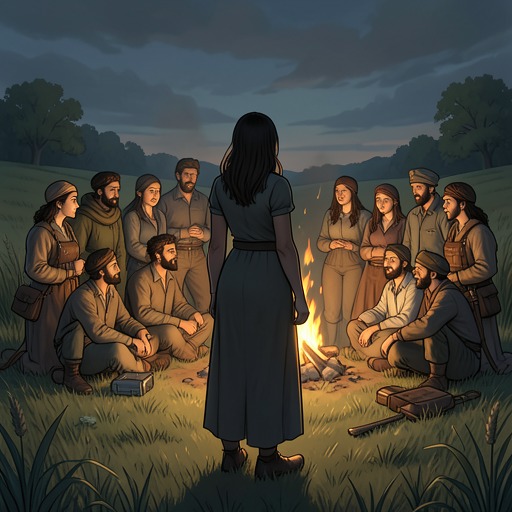
The final ascent into Aslan's country
The Last BattleThe final ascent into Aslan's country is the passage from the destroyed, temporal Narnia into a real world that exceeds it: an upward journey through impossible landscapes, reunion, and recognition that death is not the end of the story. Its repeated summons, “Further up and further in,” turns forward motion into the governing image of the ending. The survivors do not merely escape a ruined world; they discover that the world they loved was a shadow of a greater reality, and that their arrival is a beginning rather than a conclusion.
From the Waterfall to the Western Wild
The journey resumes at Caldron Pool, with the Great Waterfall thundering over high, unclimbable cliffs beyond it. Eustace calls for everyone to stop and look, but Farsight urges them onward and upward. Jewel takes the plunge first; the others follow, expecting biting cold and instead finding deliciously cool, foaming water. They are drawn straight towards the waterfall itself, an apparent danger that becomes the route forward.
At the foot of the falls, Jewel climbs or swims vertically through the torrent, his horn parting the water into two rainbow-coloured streams. Tirian follows close behind, and the rest ascend after them. The Dogs splutter and sneeze because they keep barking into the water, while the climbing party rises through reflected light and coloured stones. The impossible height would be terrifying in the ordinary world, where the water and rocks would kill a swimmer; here it is gloriously exciting. They pass over the smooth green lip into the river above, reach the bank dripping but happy, and see a long valley and snow-covered mountains ahead.
Jewel again cries, “Further up and further in,” and the company races into the Western Wild, beyond Narnia and beyond the experience of Tirian, Peter, and even Farsight. Digory and Polly recognise the country from their earlier journey on the day the world was made. The travelers follow a river through winding valleys, over steep hills, and across mountain lakes; their speed becomes closer to flight than running. At the far end of a turquoise-blue lake, they see a steep green hill crowned by a wall and trees with silver leaves and golden fruit.
The Golden Gates and the Returned Company
The travelers charge up the hill, whose steep grass offers no footing to fear, and stop before great golden gates. They hesitate, unsure whether it is right for them to enter, just as they had hesitated over the fruit. A loud, sweet horn sounds from within, and the gates open. Reepicheep appears, a small, bright-eyed Talking Mouse with a red feather in his circlet and one paw on his sword. He welcomes the newcomers in the Lion's name and calls them further in.
Peter, Edmund, and Lucy rush to greet Reepicheep. Tirian recognises the Mouse as one of Narnia's great heroes: he fought at the Battle of Beruna and sailed with Caspian the Seafarer to the World's End. Before Tirian can take in the encounter, his father, King Erlian, embraces and kisses him. Erlian is restored not as the pale, wounded king brought home after fighting the giant, nor as the grey-haired warrior Tirian remembers from later years, but as the young, merry father Tirian recalls from childhood games in the garden at Cair Paravel. The memory is intensely particular: Tirian remembers the bread-and-milk he used to eat before bed.
Other reunions gather around the entrance. Fledge greets Digory and Polly as cousins, and they hurry to kiss him. Inside the gates, the garden proves far larger than it looked from outside; its air carries a delicious fragrance, and sunlight and shade lie across springy turf dotted with white flowers. The gathered company includes Glimfeather, Puddleglum, Rilian, his mother, Caspian, Drinian, Berne, Trumpkin, Trufflehunter, Glenstorm, and heroes of the War of Deliverance. Cor arrives with King Lune, Queen Aravis, Corin, Bree, and Hwin; the Beavers and Tumnus also appear, figures from an older part of Narnia's history.
At the orchard's centre, beneath a tree where the Phoenix sits, two thrones hold King Frank and Queen Helen, ancestors of the ancient kings of Narnia and Archenland. The gathering responds with reverence, while greetings, embraces, handshakes, and old jokes join people separated by centuries. Time in this country cannot be measured by ordinary intervals: the narrator allows that the reunion may have lasted half an hour or half a hundred years. The scene makes the return of old friends more than a recovery of the past; they are present together in a place whose scale and time exceed those of the world they left.
A Greater Country and a Greater Reunion
From the garden wall, Lucy looks down on Narnia spread below and understands that the garden resembles the Stable: it is far bigger inside than outside. The view reverses the familiar relation between a bounded entrance and the world beyond it. The old Narnia is not erased from significance, but it is disclosed as smaller and less complete than the country into which the travelers have entered.
The company later sees Peter, Edmund, and Lucy's father and mother waving across a deep valley. Tumnus explains that the real countries are spurs jutting out from the great mountains of Aslan; the travelers need only walk along the ridge, upward and inward, until it joins the country beyond. As they proceed in a bright procession, the land narrows between deep valleys, while the real England draws nearer across the divide. Ahead, many-coloured cliffs form a vast staircase, and Aslan comes leaping down them “like a living cataract of power and beauty.”
The ascent thus leads beyond reunion with Narnian companions towards the children's own family and the deeper unity of the real countries. It also changes the meaning of the journey's recurring direction. “Further up and further in” is not simply a command to cover distance: the path passes from one country to another, from remembered life to a fuller reality, and from the edge of an enclosed garden towards Aslan's mountains.
Death, Recognition, and the Beginning
Aslan reveals that there has been a real railway accident. The children's father and mother, and the children themselves, are dead in the world they had called the Shadow-Lands. He describes their passage not as the end of existence but as the close of one term and the beginning of a holiday, the waking from a dream into morning. The revelation resolves why the ascent has brought the company into a reality beyond both Narnia and England: both belonged to an order that had a beginning and an end.
Digory explains that the Narnia the children knew was not the real Narnia but its shadow or copy, just as England is a shadow of something in Aslan's real world. The old Narnia that mattered, including its dear creatures, has been drawn into the real Narnia through the Door. The difference resembles that between waking life and a dream, or between a landscape seen directly and its image in a mirror: familiar, yet deeper and more wonderful in the reality beyond. The earlier world is not simply dismissed; its people and meaning survive in the greater country to which they have been gathered.
The book's final turn makes the ascent a threshold between an ending and a beginning. The characters' lives and adventures in the shadow-world become, in retrospect, only the cover and title page of the story now opening. The final ascent brings them into a life whose chapters continue without end, each better than the last. Its decisive movement is therefore not escape from death but passage through death into the real story.